Below are some things I’ve written about teaching History.

CAN THE ‘SUBALTERN’ SPEAK YEAR 8S?
When the Indian scholar and literary theorist Gayatri Chakravorty Spivak asked this question in 1988, she wasn’t asking Year 8s on a Monday morning. What she wanted to explore was whether those marginalised people written out of the archive – ‘the subaltern’ – could be written back in.
Publication :
TEACHING HISTORY
191
Date Written:
JUNE 2023
Tags:
#historyfrombelow #evidentialunderstanding #transatlanticslavery

AN ARGUMENT FOR TURNING OUR STUDENTS INTO ‘OCEAN DIVERS’ BY ‘PRESSING AT THE LIMITS’ OF THE ARCHIVE.
When Gayatri Chakravorty Spivak asked in 1988 ‘Can the subaltern speak?’ she wasn’t asking Year 8s on a Monday morning. But, as with a long line of thinkers interested in whose stories get told and how, she articulated something that our Year 8s should be thinking about.
Publication :
ONLINE
Date Written:
APRIL 2023
Tags:
#historyfrombelow #evidentialunderstanding #transatlanticslavery

TELLING DIFFICULT STORIES ABOUT THE CREATION OF BANGLADESH
I decided to talk to Ferdousi… but I knew that a conversation with Ferdousi was going to be one of the most difficult ones I had ever had. I certainly didn’t want to probe her insensitively for the sake of my research. I thus decided to walk into her house without any set questions or agenda; I wanted to let her speak to me, to tell me what she wanted to, as she wanted to.
The Year 9s are hooked by this introduction to our enquiry.
I have told them that Ferdousi Priyabhashini is a hugely significant figure – an artist known throughout Bangladesh and across the world. They know that Anam Zakaria, the experienced historian who wanted to tread so carefully, had done hundreds of interviews before. And I’ve asked them a simple question:
Why might Ferdousi’s story be so difficult to tell?
Publication :
TEACHING HISTORY
188
Date Written:
SEPTEMBER 2022
Tags:
#oralhistory #bangladesh #historyfrombelow #evidentialunderstanding #interpretations
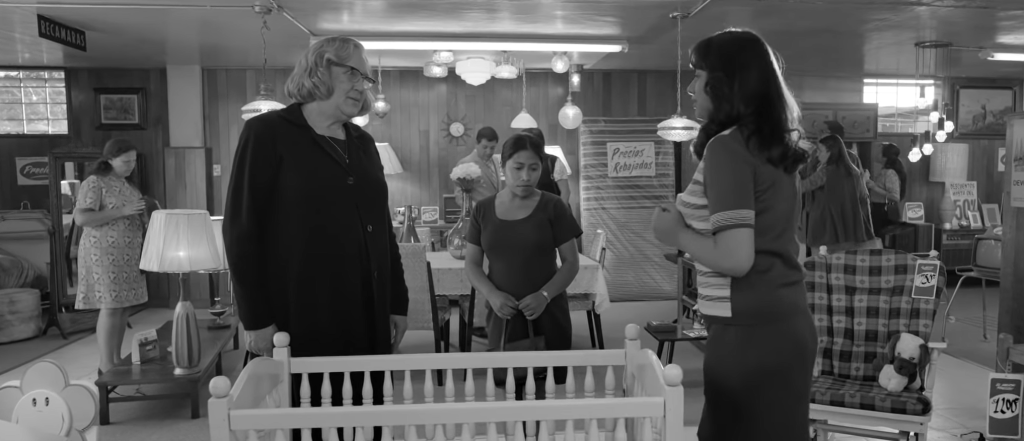
STAYING WITH THE SHOT
shaping the question, lengthening the narrative and broadening the meaning of transatlantic slavery
New meaning can be found by staying with a story beyond its conventional end. Not
only do we find out more; we begin to review what went before.
Film director Alfonso Cuaron is a master of this trick. Deep into his Oscar winning film Roma we follow our protagonist on what looks like a familiar shopping trip, but soon it turns into something violently unfamiliar. As Cuaron stays with the shot, refusing to cut, we see the whole story anew.
Publication :
TEACHING HISTORY
180
Date Written:
OCTOBER 2020
Tags:
#transatlanticslavery #coursework #enquiry #changeandcontinuity

SHOWING ROOTS
All students in England learn about William the Conqueror. Most study Henry VIII. Some will do the causes of WWI. If you get to GCSE you’ll almost certainly be examined on the Nazis.
As adults, the list of what we remember learning in our history classrooms vary from person to person. People regularly enjoy regaling me with their own memories and experiences at school when they hear of my job. It’s an inexact exercise; some lessons you forget, others you were passing notes in and, dare I say, quite a few probably weren’t taught that well.
 Another History is Possible